

When Does Parkinson’s Begin?
Disclaimer: This article is an opinion piece intended for general informational purposes only. It is not medical advice and should not be used to diagnose, treat, or manage Parkinson’s disease or any other medical condition. Readers should consult a qualified healthcare professional for medical advice specific to their circumstances.
For years, Parkinson’s has been explained in a remarkably simple way: dopamine-producing neurons in a part of the brain called the substantia nigra die, dopamine levels fall, and Parkinson’s disease follows. But that explanation describes Parkinson’s from the point where it becomes visible as a movement disorder, not necessarily from where it actually begins.
Researchers now know that Parkinson’s-related pathology can be present for years before the familiar symptoms of slowed movement, rigidity and tremor appear. Roughly 90% of people with Parkinson’s experience one or more non-motor symptoms before the onset of recognizable motor symptoms.¹ Non-motor symptoms may include constipation, loss of smell, REM sleep behavior disorder, depression, anxiety, autonomic dysfunction, fatigue and other changes.
Medicine calls this the prodromal phase of Parkinson’s. The Movement Disorder Society has formally developed research criteria for identifying people who are likely to be in this phase. In other words, the medical community already recognizes that the biological process can begin before the traditional clinical diagnosis, raising an important question:
If the biological Parkinson’s process could be reliably identified during this non-motor, prodromal phase, would Parkinson’s disease still be defined as beginning when bradykinesia appears?
The dopamine problem
In Parkinson’s disease, the neurons that produce dopamine in the substantia nigra are progressively lost, and dopamine replacement with levodopa can produce dramatic improvements in the classic motor symptoms of Parkinson’s. That’s why dopamine loss is the focus of so much of Parkinson’s research and treatment. But dopamine loss doesn’t explain the non-motor symptoms.
Researchers have known for years that Parkinson’s involves multiple neurotransmitter systems, including glutamate, GABA, acetylcholine, serotonin and norepinephrine. There’s also growing research involving adenosine, histamine, neuropeptides and opioid systems, and the endocannabinoid system. Parkinson’s affects interconnected neural systems, and dopamine is only one of them.
The bigger chemical picture
Among the neurotransmitters being studied are:
Dopamine: Central to movement, motivation, reward and several cognitive functions. Degeneration of the nigrostriatal dopamine system is particularly important to the classic motor syndrome.
Norepinephrine: Produced largely by neurons in the locus coeruleus. Noradrenergic degeneration is associated with aspects of autonomic dysfunction, sleep problems, attention, mood and other non-motor features.
Serotonin: Involved in mood, sleep, appetite, sensory processing and many other functions. Serotonergic neurons and their connections are affected in Parkinson’s, and serotonin interacts extensively with dopamine circuitry.
Acetylcholine: Important for attention, cognition, movement and autonomic function. Cholinergic dysfunction is particularly relevant to cognitive impairment, gait and balance problems and other non-motor symptoms.
Glutamate: The brain’s principal excitatory neurotransmitter. Abnormal glutamatergic signaling may contribute to changes in basal-ganglia circuitry, motor complications and potentially excitotoxic stress.
GABA: The brain’s principal inhibitory neurotransmitter. GABAergic circuits are fundamental to the basal-ganglia networks that regulate movement, and their function changes as Parkinson’s disrupts those networks.
Adenosine: A neuromodulator deeply intertwined with dopamine signaling in the basal ganglia. Adenosine A2A receptors have become an important therapeutic target in Parkinson’s, particularly for motor complications.
Histamine: Involved in wakefulness, attention and autonomic and metabolic regulation. Histaminergic systems are increasingly being investigated in Parkinson’s, particularly in relation to sleep and other non-motor features.
Neuropeptides and opioid systems: Including substances such as enkephalins, dynorphins and substance P, these help regulate pain, motivation, movement and the activity of basal-ganglia circuits.
Endocannabinoids: Signaling molecules such as anandamide and 2-AG that regulate neurotransmitter release and interact with dopamine, glutamate and GABA systems. Their role in Parkinson’s is an active area of research.
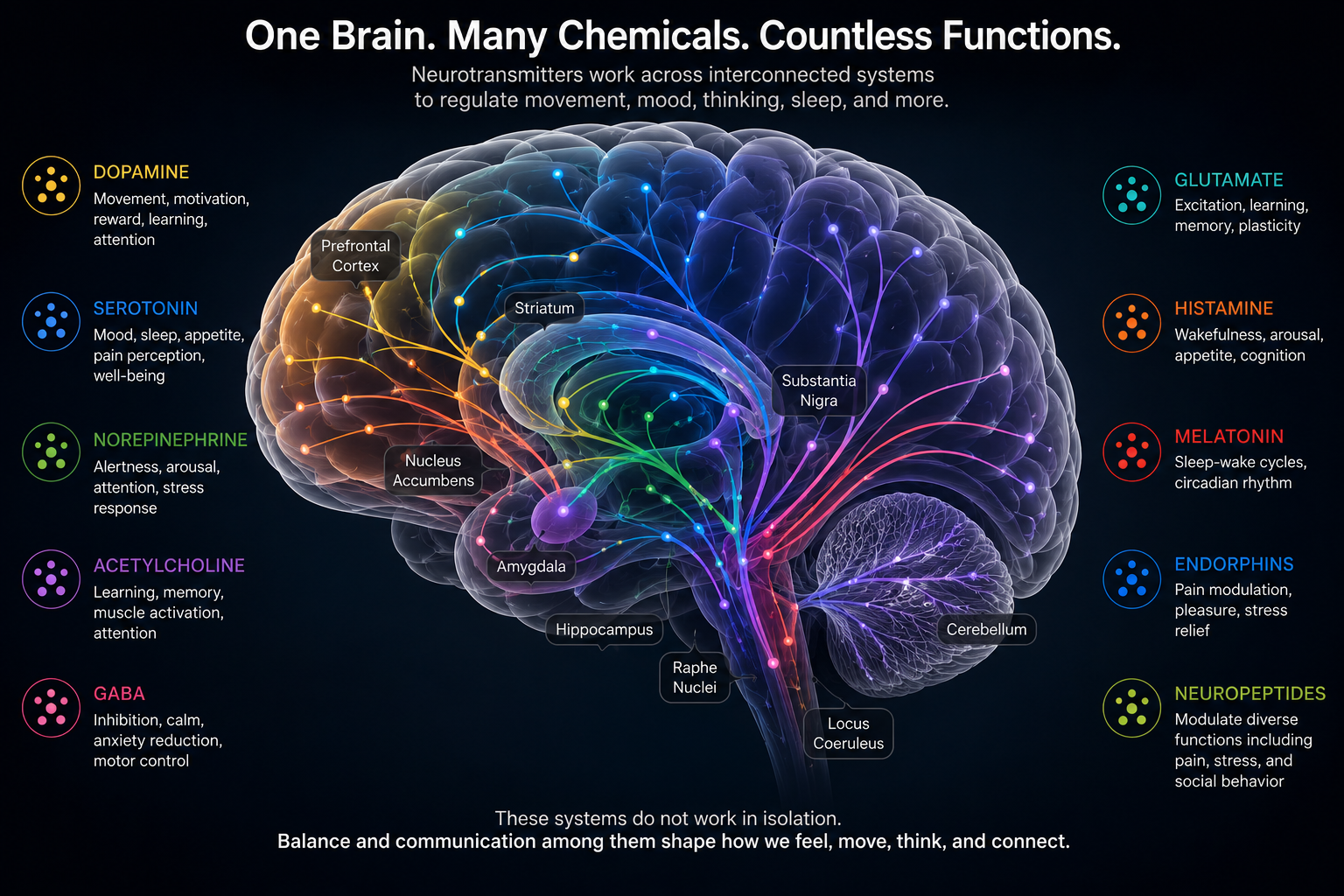
Some of the neurotransmitters that can be involved in Parkinson’s
Researchers are investigating mechanisms including abnormal neural activity, excitotoxicity, oxidative stress, mitochondrial dysfunction, inflammation and changes in synaptic signaling. While there’s no evidence that damage to one neurotransmitter system directly causes dopamine neurons to die, the evidence increasingly shows that Parkinson’s involves multiple interacting neurotransmitter systems, not simply the loss of dopamine.²
What if dopamine isn’t where Parkinson’s begins?
The traditional model naturally directs attention to the substantia nigra because that’s where one of the most obvious forms of neuronal loss occurs. But there’s no proof that the substantia nigra is where Parkinson’s begins.
One influential hypothesis, based on pathological observations, proposed that Parkinson’s pathology might begin outside the brain, including in the gastrointestinal nervous system, and subsequently spread toward the brain. Other hypotheses have emphasized the olfactory system. Autopsy evidence hasn’t established a single route of disease initiation, and the field now recognizes considerable variation among people with Parkinson’s. Recent research describes competing and potentially complementary models, including brain-first, body-first, olfactory, gut, multifocal and other pathways.
The disease could represent the eventual convergence of several biological processes: abnormal alpha-synuclein, genetic vulnerability, environmental exposures, mitochondrial dysfunction, immune and inflammatory responses, impaired cellular waste disposal, changes in the gut or olfactory system, and other factors. Exactly how these pieces fit together is an active area of research.
The prodromal phase changes the question
A person can develop REM sleep behavior disorder years before ever experiencing parkinsonism (slowed movement, stiffness and/or tremor). The same is true of other symptoms, particularly when they occur in combinations.
That doesn’t mean everyone with constipation, depression or RBD has Parkinson’s. Some of these symptoms are common and extraordinarily nonspecific. But when particular symptoms occur together in people with other risk markers, the probability of eventually developing Parkinson’s becomes remarkably high. Researchers typically study these early non-motor symptoms as prodromal markers, acknowledging they may represent early Parkinson’s biology while still reserving the clinical diagnosis of Parkinson’s for a later stage.
Why hasn’t medicine simply changed the definition?
The current clinical criteria require parkinsonism, centered on bradykinesia with other characteristic motor features. The Movement Disorder Society continues to regard those criteria as the global clinical standard. With increasing focus on prodromal, non-motor symptoms, why not change them?
Changing a disease definition isn’t a simple matter. We need a reliable biological marker that tells us with confidence that a person actually has the underlying disease, and that marker would need to work across the enormous biological diversity of Parkinson’s.
We are getting closer, though. The development of alpha-synuclein seed amplification assays, which can detect pathological forms of alpha-synuclein in biological samples, has been an important advance. Researchers have proposed biological definitions of Parkinson’s-related disease based on the presence of pathological alpha-synuclein rather than waiting for the clinical motor syndrome to appear.
But important questions arise.
How early can these tests reliably detect disease?
How accurately do they predict future progression?
Does everyone with pathological alpha-synuclein develop the same disease?
Can we distinguish different biological subtypes?
And how should someone who has a positive biomarker, but no symptoms be counseled?
There’s another huge question: What would we do differently?
There’s currently no universally established disease-modifying treatment that we can give someone with biomarker-positive, symptom-free Parkinson’s to prevent or delay the disease. Until that changes, widespread biological diagnosis creates difficult questions about anxiety, labeling, insurance, employment, medical surveillance and treatment, so researchers have good reason to proceed cautiously.
But the field is already moving
The important thing is that the old definition may not be the final definition. In 2024, an international group proposed a biological definition of neuronal alpha-synuclein disease based on detecting pathological alpha-synuclein, independent of whether the person has developed the traditional clinical syndrome. Another emerging framework, the SynNeurGe concept, similarly separates the biological features of Parkinson’s from its clinical manifestations.³
The debate over whether Parkinson’s should eventually be defined biologically rather than exclusively clinically is happening inside the Parkinson’s research community right now. The Movement Disorder Society itself has acknowledged that pathological processes can begin many years before clinical parkinsonism, and substantial loss of nigrostriatal dopaminergic neurons may already have occurred by the time the traditional clinical syndrome becomes apparent.
Why patients hear so much about dopamine
There’s another reason dopamine dominates the Parkinson’s conversation: it’s the easiest part of the disease to connect to a treatment. Treat low dopamine with levodopa and get improved movement. It’s a clean story, but Parkinson’s is anything but clean. People can have significant non-motor symptoms while their motor examination is still relatively normal, while others may have severe tremor but little cognitive or autonomic dysfunction. These differences may reflect which neural systems are affected and when.
The dopamine-centered view can also lead to an unfortunate misunderstanding. Constipation, loss of smell, REM sleep behavior disorder, depression, fatigue and autonomic problems aren’t specific enough to diagnose Parkinson’s, but that doesn’t make them unrelated to the disease. Several are recognized features of prodromal Parkinson’s, particularly when they occur together. The challenge is distinguishing early Parkinson’s from symptoms that are common in people who don’t have the disease.
We may be defining the disease from the wrong end
Perhaps the most useful way to think about this is as a timeline:
Biological disease → Subtle cellular and neural dysfunction → Non-motor/prodromal symptoms → Increasing involvement of multiple neural systems → Dopaminergic dysfunction becomes clinically apparent → Bradykinesia ± rigidity/tremor → Traditional clinical diagnosis
If that sequence is substantially correct, then the conventional diagnosis doesn’t identify the beginning of Parkinson’s. It identifies the point at which Parkinson’s becomes clinically recognizable enough to name. That distinction could become enormously important when therapies capable of slowing or preventing progression are developed.
Imagine two approaches.
The first waits until a person has obvious bradykinesia and has already lost a substantial proportion of vulnerable dopaminergic neurons.
The second identifies a biological Parkinson’s process years earlier, perhaps through a combination of alpha-synuclein biomarkers, genetics, imaging, autonomic testing, sleep history, smell testing and other measures, and then intervenes before substantial neuronal loss has occurred.
The second approach is obviously more attractive, but getting there will require moving beyond the idea that Parkinson’s begins when movement slows.
Rethinking the Definition
Parkinson’s is still diagnosed clinically, primarily based on motor symptoms. That makes sense given the limitations of current diagnostic tools and the fact that many non-motor symptoms are common and nonspecific. But if biological changes are already underway years before bradykinesia appears, then the conventional diagnosis is identifying a later stage of Parkinson’s, not necessarily its beginning.
As researchers learn more about the systems responsible for prodromal, non-motor symptoms and develop better biomarkers, the diagnostic criteria may eventually evolve toward earlier diagnosis and more global treatment. That could change not only when Parkinson’s is diagnosed, but how the disease itself is understood.
References:
¹ Durcan, R., Wiblin, L., Lawson, R. A., et al. (2019). “Prevalence and duration of non-motor symptoms in prodromal Parkinson's disease.” European Journal of Neurology, 26(4), 655–661.
² Coukos, R., & Krainc, D. (2024). “Key genes and convergent pathogenic mechanisms in Parkinson disease.” Nature Reviews Neuroscience, 25, 393–413.
³ Höglinger, G. U., Adler, C. H., Berg, D., et al. (2024). “A biological classification of Parkinson's disease: the SynNeurGe research diagnostic criteria.” The Lancet Neurology, 23(2), 191–204.